
SoSaLa: 1987 LP Re-released on CD!!! A Refreshing Old Tokyo Story.
“I like his punishing saxophone solos, his creative use of props, and his obtuse criticisms of modern life delivered in various languages.” – Bryan Harrell (BOP SHOTS/JAPAN TIMES), August 29, 1989
Album Information
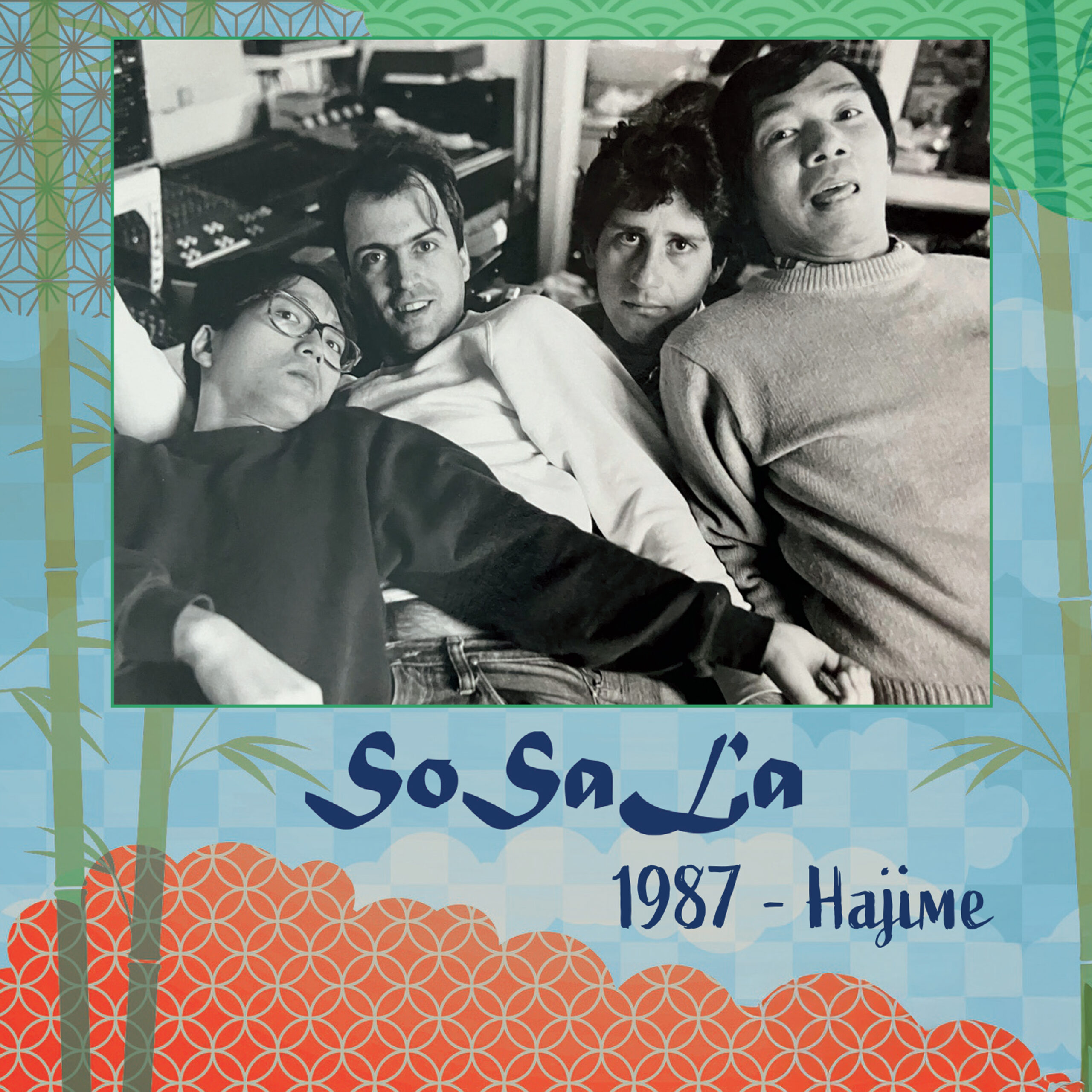 Artist: SoSaLa
Title: 1987 – Hajime
Formats: CD and digital download
(An autographed, numbered and a 24 bits high resolution mastered limited edition of 100 CDs)
Label / Cat.#: DooBeeDoo Rec / DBDCD006
UPC Code: 199900927491
CD Release: April 1st, 2026
International CD and Digital Releases: April 30th, 2026
Stream here:
Buy here:
Website: www.Sohrab.info
All tracks composed by Sohrab Saadat Ladjevardi
© Sohrab Saadat Ladjevardi – ℗ DooBeeDoo Worldwide Music / BMI
Produced by SoSaLa
Recorded by H. Nagasawa (tracks: 1, 2, 4, 6, 7, 8, and 10), T. Inagaki (tracks: 3, 5, 9) at White House, Tokyo, February/March 1987
Photos by Ryutaro Hidaka
Mastered by Adam Reifsteck (Teknofonic Recordings, LLC, New York)
Manufactured and printed in the USA
SoSaLa has released another retrospective CD. This time, re-releasing the 1987 LP ALEF “Hajime!”, originally released on SoSaLa’s independent label, Kampai Records. “Alef” is the first letter of the Iranian alphabet, describing the beginning of SoSaLa’s music career with that LP release.
The LP is still available on SoSaLa’s website or online. Sold at a premium price.
This retrospective album is another must for fans interested in SoSaLa’s interesting and accomplished music career. The music on this album comes from the Japanese free jazz-punk-noise scene of the 80s. No band in Japan sounded like ALEF, a short-lived but pioneering multimedia performance group active in the mid-1980s.
The music was a Dadaistic blend of jazz-core, progressive rock, and avant-garde, often described as “rock-jazz-industrial” with heavy improvisation.
The contributions of all musicians on this album add unique dimensions and startling voices, enhancing an already compelling and potent mix.
The music sits well with rock and jazz, yet transcends both genres.
ALEF (1985-1987) (Hi)Story
In 1984, when SoSaLa lived in Osaka and was known as Sadato, he decided to disband his Osaka band, SADATO GROUP, even though it had established itself as a powerful group. He felt musically stuck in Osaka and needed another “kick” to grow in the Japanese music scene and in his career. He moved to Tokyo, Japan’s entertainment and music center. With its many record companies and publishers, Tokyo was the best place for a professional musician and band leader to grow.
When SADATO GROUP played in Tokyo, Sadato invited local musicians to perform with him, such as Tom Hojnacki from the US on drums and percussion, Douglas Lamont from Canada on keys and vocals, a striptease dancer, and Butoh dancers from the Butoh dance group Hoppoh Butoh Ha.
He contacted all of them and invited them to rehearsals to form a new band. He also looked for new members—this time, jazz musicians who could also play rock.
At a Karl Berger Orchestra gig in 1984, he became friendly with the jazz bassist Yo Nakamura. They decided to jam, and Nakamura invited the jazz drummer Tatsuya Ishida to join them. Together, they had such a good time playing that Sadato decided to form a band with them, ALEF. Later joined by Tom Hojnacki (percussion), Douglas Lamont (keys), and Dennis Gunn (guitar), whom he met at an ESL school in Tokyo.
Unfortunately, Nakamura left the band for personal reasons and decided to live with his family in the countryside. Gunn joined the band who brought a young jazz-rock musician on acoustic and electric fretless bass, Hideki Kato, into the band. This was the birth of ALEF, consisting of a jazz drummer, a kind of Adrian Belew guitarist, and a Jack Bruce bassist.
The lineup and instrumentation were: Sadato (saxophones, synthesizer, flute, and vocals), Dennis Gunn (guitars and vocals), Hideki Kato (electric and acoustic bass and vocals), and Tatsuya Ishida (drums and vocals). With special guests Toshiko on synthesizer and Romi on voice.
The photographer, Ryutaro Hidaka, was a friend of Kato’s who later fell in love with ALEF. He became the band’s regular photographer.
After a couple of gigs that were well-received by the audiences, Sadato felt they had enough material to record an album. Gunn found a studio on the outskirts of Tokyo. The studio owner, H. Nagasawa, who attended one of ALEF’s concerts, invited them to record at his White House Studio. He and his assistant, T. Inagaki, were behind the recording board.
Unfortunately, after the LP was released, Ishida and Gunn decided to leave the band. A couple of months later, he formed his next band with Kato, SADATO.
Quotes
“I’d like to praise the inventiveness of the conception and their new direction. Stateless music does not, of course, encourage us some land’s vistas, but there are indeed sights to be seen. So this must be visionary music.” – Legendary jazz critic Teruto Soejima (Ensemble, January 1988)
“I like his punishing saxophone solos, his creative use of props, and his obtuse criticisms of modern life delivered in various languages.” – Bryan Harrell (BOP SHOTS/JAPAN TIMES), August 29, 1989
Album Review
“Hajime sounds much like an ALEF performance, full of provocative chords, riffs, and just plain weird noises accompanying lyric passages suggesting dream-like states, non-shared reality, and stop-action flashes of insight. Most elections have Japanese lyrics, including the haunting ‘Ningen,’ the mysteriously dramatic ‘Bachan No Tea Time,’ and ‘Sarariman Shine,’ a portrait of fear and dread in the white-collar workforce.” – Bryan Harrell (Japan Times), June 7, 1988
The Tracks
1. SINCRO – 2:05
2. NINGEN – 4:37
3. TSUBANA – 3:01
4. PACHINKO BREEZE – 3:03
5. SARARIMAN SHINE – 6:06
6. TOUCHE PAS A MON POTE – 3:19
7. LEILA – 4:56
8. NANJI DESU KA – 1:16
9. BACHAN NO TEA TIME – 2:50
10. WHEN I’M CRAZY I’M NORMAL – 6:01
About the Musicians
SoSaLa (who called himself Sadato in Japan) – whom the legendary jazzman Ornette Coleman, one of SoSaLa’s mentors, described later as “the freest rock saxophonist” is a saxophonist/band leader/composer/improviser and who has lived and performed in Switzerland (1953), Germany (1953 – 1974), Japan (1974 – 2008), and the US (2008 – present).
During his Japan residency, he had performed and/or recorded as a leader with his bands (Sadato-Ino Group, SADATO GROUP, ALEF, SADATO, The Tehran-Dakar Brothers, a.o.) and with Karl Berger, Toshinori Kondo, Motoharu Yoshizawa, Hideo Yamaki, Mototeru Takagi, Eugene Chadbourne, Peter Gordon, Vinny Golia, The Blech, TWILIGHT CIRCUS, with the Butoh group Dai Rakuda Kan, Salif Keita, Wagane N’Diya Rose, Fanfare Ciocarlia, Warsaw Village, a.o. He toured with his respective bands in Japan, Europe, the US, Hong Kong, and Mali.
He released many CDs on his own label. Some of them were released in Europe and played at prestigious clubs and festivals in Japan and around the world. Wherever he went, interviews were done and published in Japanese, German, French, and Spanish.
He also released a couple of short film videos documenting his life and music in Tokyo, directed by indie filmmaker Steve Black.
Sadato was renowned in Japan for his saxophone and stage performances. He became a notable figure in the Japanese free jazz and indie rock scenes due to his multimedia (music, video, and stage performance) and multilingual (English, German, Japanese, and Farsi) performances. SADATO GROUP was the only band blending elements of (free) jazz, rock, and Middle Eastern 6/8 and modes into its performances.
As an instrumentalist and composer, he was musically influenced by Japanese free jazz musicians such as Yamashita Yosuke and improvisers such as Toshinori Kondo. As a singer, he draws inspiration from vocalists such as Jim Morrison, Captain Beefheart, Johnny Rotten, flamenco, and Persian classical singers. And as a stage performer, he incorporated Butoh dance, mime, and martial arts movements.
Sadato’s unique background—Iranian, living in Japan, and practicing martial arts—allowed him to bring a distinct cultural and musical fusion to his work, which resonated across different genres and audiences.
His tenor and soprano saxophone playing was unique and original. He didn’t care for technique so much as the sound of the sax. He was self-taught and never studied music. He left the “talking” primarily to his sax and the other instruments he played: guitar, drums, harmonica, flute, synthesizer, and the flute. His work often features an expressive, fluid style that enhances the overall atmosphere of the music, whether in live performances or recordings.
His music may appeal to listeners who enjoy experimental jazz or cross-cultural collaborations. Through performance and music, Sadato was a great communicator with the audience. Sometimes, he would invite an audience member to join the band.
In addition to his unique work as a musician, Sohrab was also the president of the music record company, POP BIZ Rec, and CD import distributor POP BIZ Ltd (1993-2008). From 2004 to 2007, he was also the chief editor of the Tokyo cross-cultural music magazine Doo Bee Doo Bee Doo, published by POP BIZ Ltd.
In 2005, Sadato organized the international world music festival DOO BEE FES in collaboration with SMASH CORPORATION in the old city of Tokyo.
He was also known in Japan as an incisive interviewer, in particular for a series of interviews he conducted for Jazz Critics (one of the top Japanese JAZZ journals), with Horace Silver, Don Cherry, Michel Petrucciani, Larry Oakes of the Rova Saxophone Quartet, Elliott Sharp, Lynn Johnston, Vinnie Golia, Peter Gordon, THE BLECH, engineer/producer Martin Bisi, Akita Masami, and Scott Baker, editor of Option (US music magazine).
Read his complete bio here: https://sohrab.info/bio-2/.
Tatsuya Ishida
In 1971, he formed the Ishida Tatsuya Quintet. Performing at the legendary jazz club, the Pit Inn.
In 1977, performing with the XXX at the SUMMER JAZZ FESTIVAL and ALL-NIGHT JAZZ FESTIVAL.
1980 Performing two nights with Eugene Chadbourne. Joining the Yoshizawa XXXX GROUP
1983 – 1985…
Hideki Kato
After leaving ALEF, he founded his first band, PIANO PLAYER, in 1987.
Several distinct phases and innovative projects characterize his post-ALEF work:
Ground Zero (1990–1992): He was a founding member of this seminal Tokyo noise unit led by Otomo Yoshihide.
Death Ambient (1995–Present): Formed in New York with Fred Frith and Ikue Mori, this trio released three albums on John Zorn’s Tzadik Records, including Death Ambient (1995), Synaesthesia (1999), and Drunken Forest (2007).
Green Zone (2004–2008): Kato led this trio featuring the original Ground Zero lineup. They released two albums, Green Zone (2005) and Bayt (2008), inspired by the US invasion of Iraq.
OMNI (2009): A collaborative project with Toshimaru Nakamura and Tetsuzi Akiyama.
Plastic Spoon: His more recent rock-and-roll project for which he plays bass and writes both music and lyrics, featuring Karen Mantler and Shahzad Ismaily.
Dennis Gunn
Dennis Gunn, also known as Dionisius and T.I.M., is an American producer/songwriter/vocalist/ voice and TV actor. He is an American musician and actor from Washington. Since 1985, he has lived in Tokyo.
After leaving ALEF, he served as the guitarist for the influential new wave band Yapoos, fronted by the legendary actress Jun Togawa.
In 1993, he formed his own rock band, Mighty John Henry, in Tokyo, where he serves as the primary songwriter, lead vocalist, and guitarist. Meanwhile, Dennis has also appeared in television commercials and in NHK’s drama Ryomaden (龍馬伝).
Fans of rhythm games may recognize his guitar and vocal work from the GuitarFreaks and DrumMania series, including tracks like “KING G” and “Tail Spin” (on BEMANI / Konami)
Toshiko
When Gunn was the guitarist for a Tokyo indie rock band, Toshiko was the keyboard and synthesizer player. Dennis introduced Toshiko to Sadato, who later invited her to play on track #7.
Romi
Romi was a makeup artist who spoke the Kyoto dialect on track #9.
About the Tracks
SINCRO
Sadato was a fan of the Korg MONO POLY analogue synthesizer. In particular, he liked to play with its sequencer or arpeggiator. With the sound of the sequencer in mind, he had the idea to record howling voices, a flute sounding like a Japanese fue or Shakuhachi, a Shamisen-like guitar, and taiko drumming. By combining all these sounds, Sadato achieved a modern version of Japanese Shinto temple chanting.
NINGEN (Human Being)
“Ningen” means human being in Japanese. As you know, since the end of WW2 Japan has become a very crowded country. America made Japan one of its colonies. Exporting US culture and capitalism to a poor country. To do so, Japan first needed to get back on its feet economically. The corporations and companies took care of their employees and workers. A kind of democratic socialism was born.
Unfortunately, while working hard to realize the “Japanese dream,” the Japanese started to lose their identity and become unsociable with each other.
Sadato is taking on the role of Diogenes of Sinope (4th century BC), an ancient Greek philosopher and founder of Cynicism. This philosophy emphasizes a simple life free from possessions, power, fame, and money. He was known for his extreme asceticism, rejecting societal norms, and living in a large ceramic jar. He was notorious for carrying a lamp during the day to search for an honest man.
Sadato is taking over Digenese’s role and is looking for real people (“ningen”) at the famous Shibuya Crossing near Shibuya Station. a major commercial and entertainment district in Tokyo. It has been described as the world’s busiest pedestrian crossing, with as many as 3,000 people crossing during a single green light cycle.
This song is dedicated to Diogenes.
TSUBANA
“Tsubana” (also known as cogongrass or Imperata cylindrica) is a common motif in traditional Japanese culture, often appearing in poetry and folk contexts as a symbol of spring or late summer. While it is less commonly the title of a specific folk song,
This said, Sadato heard this song or the melody somewhere in Osaka. He liked it so much that he made a new composition out of it. He chose the same instrumentation as “Sincro.” Again, Sadato created a modern version of traditional Japanese music. This time it’s an unknown, mysterious Japanese folk song.
PACHINKO BREEZE
Pachinko is a Japanese mechanical game that originated in Japan and is now used as an arcade game and, much more frequently, for gambling. Pachinko fills a niche in Japanese gambling comparable to the slot machine in the Western world, serving as a low-stakes, low-strategy game.
Pachinko parlors, run by ethnic Koreans, are widespread in Japan, and usually also feature several slot machines. You can often find them around subway stations or shopping malls.
A drawback of slot machines is their noise. When you open the parlor’s door, a loud and noisy “Pachinko sound breeze” welcomes you in. There’s no way to reach someone. So, this song describes the moment when you approach the parlor, open the door, walk in, and start playing.
SARARIMAN SHINE (Salariman Die)
The term sararīman (salaryman in English) is a Japanese word for salaried workers, employees, or white-collar workers. Becoming a sararīman, especially for a major corporation, is a traditional path to prestige, representing financial security and a good life. However, it was essential to demonstrate unwavering loyalty and commitment to their employers or companies, prioritizing work over everything else, including family. Sararymen are expected to work long hours, whether overtime is paid or not. They socialize with colleagues and bosses, including singing karaoke, drinking, and visiting hostess bars.
In this song, Sadato is very critical of these hardworking sararimen and their way of life, calling them “dead people” because of their lack of individuality and their willingness, even on occasion, to be overburdened to the point of karōshi, or death from overwork.
This song made a lot of noise in music mag reviews, commentaries, and among ALEF fans. Sadato broke a taboo that wasn’t one.
TOUCHE PAS A MON POTE (Hands off my friend)
“Hands off my friend” (“TOUCHE PAS A MON POTE in French) is the official slogan of the French association SOS Racisme, a politically left-wing international movement of anti-racist NGOs, founded by Julien Dray and Harlem Désir. The slogan was launched during the 1985 SOS Racisme concert and reached its peak by August 1987, and then declined from then on, in November 1987, due to its close association with the Socialist Party and the deaths of figures like Simone Signoret, Daniel Balavoine, and Coluche, who contributed to its influence, even though it still exists today.
As a foreigner in Japan who experienced some “soft” discrimination, Sadato sympathized with this group and expressed that in this song.
LEILA
The name Leila is derived from the Arabic language, meaning “night” or “black”. Leila holds significance in Arabian and Persian folklore, where the night is associated with mystery, beauty, and enchantment.
Sadato chose this name for this song because it carries a sense of mystique and beauty. Leila symbolizes Sadato’s love and longing for his first home country, Iran.
NANJI DESU KA (What Time is It?)
“Nanji desu ka” means “what time is it?” in English. The interpretation of this tune is left to the listener. Why can you hear two guys fighting? Why do you hear a clock sound? Who’s dropping a cymbal?
The interpretation of this tune is left to the listener.
BACHAN NO TEA PARTY
This tune is a parody of an old Geisha enjoying green tea, accompanied by pseudo-shamisen music played on Gunn’s guitar and Sadato’s flute, imitating a shakuhachi. Romi is reciting in a Kyoto dialect. Bachan means “old lady” in Japanese.
WHEN I’M CRAZY I’M NORMAL
Throughout his stay in Japan, Sadato was unable to integrate into Japanese society. He had always been called “Nazo No Sadato,” which means “Strange or Mysterious Sadato.” Whatever he said and did was unfamiliar to the Japanese. Even his music wouldn’t connect him with the Japanese public. It was accessible only to a small number of fans. There was no way he would get signed by a label.
So, to fit well in Japanese society, he had to remind himself that he was an April Fool—a character who always does the opposite of what people expect from him. So to look normal, he had to play a crazy guy and vice versa.